
“Fortunes are made when cannonballs bombard the harbors, not when violins play in the ballroom.”
– Baron Rothschild
An important lesson from investment history is that the best time to buy is when there is bad news, not good news. When news is good, stock prices will be high. Therefore, good news is not the best time to buy. On bad news, stock prices crash, making them attractive buys. So, the best news may turn out to be the worst time to buy, and the worst news often turns out to be the best time to buy. That is why the famous banker and successful investor Rothschild said that fortunes are made when people invest when war breaks out, and not when there is peace and everything is good. Rothschild went on to say that “the best time to buy is when there is blood in the street.” When the news is very bad, most people panic, sell, and try to get out of the market. This panic creates great opportunities to buy for those who are courageous to swim against the current.
Some of the legendry investors are contrarian investors. They swim against the current. It takes courage to buy when there is fear and panic in the market. But investment history tells us that those investors who muster the courage to buy amidst panic and remain invested with patience, reap spectacular rewards.
It is well known that greed and fear are normal human emotions. These emotions manifest in the behaviour of the crowd. This is herd instinct. When a crisis strikes, the herd panics and rushes to sell. The market overreacts and crashes. Successful contrarian investors step into this panic-stricken market and bet heavily against the trend. Soon panic subsides, normalcy is restored, and the market starts climbing up. This strategy of what Warren Buffet called “being greedy when others are fearful” is a strategy that has created phenomenal wealth for contrarian investors. It is important that when prices crash and valuations become highly attractive, stocks have to be bought in large quantities. As Warren Buffet famously said, “when it rains gold, we go out with bathtubs, not buckets.”
Investment history tells us that big crashes were excellent buying opportunities. Let’s take the time period since 1980. In the US, since 1980, there were five years when the S&P 500 crashed by more than 25 percent: 1987: -32.9 percent, 2001: -26.1 percent, 2002: -31.4 percent, 2008: -36.4 percent, 2020: -33.8 percent. Those were years of high panic, huge uncertainty and loss of confidence. But in hindsight, it became clear that the markets had overreacted on the downside. Those contrarian investors who correctly understood this overreaction, and bought into the mayhem, reaped spectacular returns when the markets bounced back after the crash. The years following the crashes mentioned above were years of smart recovery and handsome gains in the market.
Learnings from market crashes
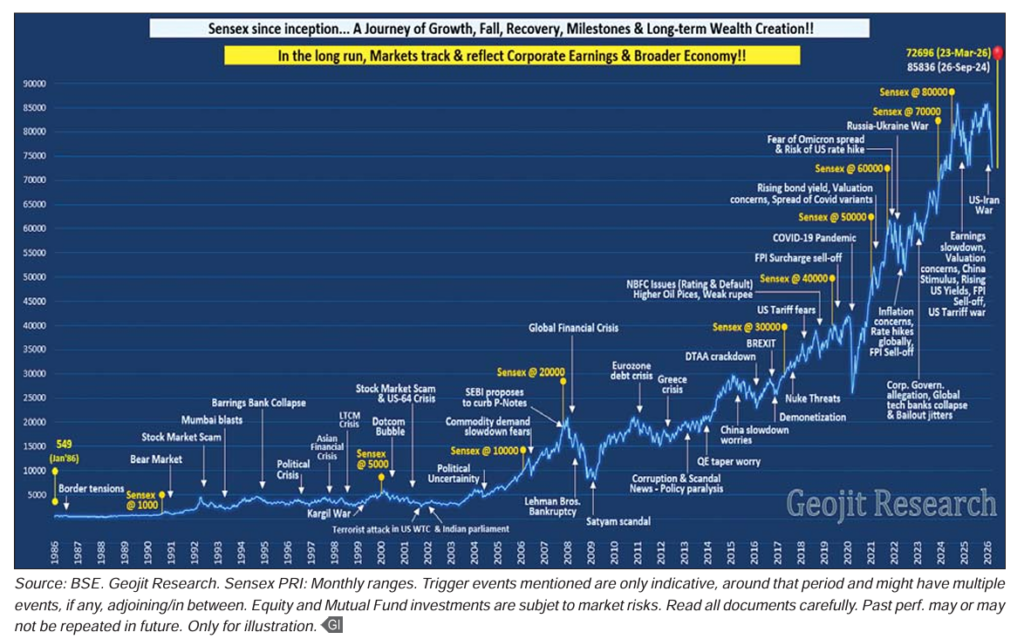
Let’s look at the journey of the Sensex from 100 in 1979 to where it is now. The market faced many crises like assassination of prime ministers, political instability, wars, natural calamities, sanctions and economic crises. Apart from these domestic crises, the market was impacted by global economic crises and market meltdowns.
What happened after these crashes?
The important question is: what happened after all these crises? Each time, the market recovered. Sometimes markets bounced back sharply; at other times, the recovery took time. To put it briefly, the Sensex recovered after each crisis and moved up in tune with corporate earnings. The journey was certainly not smooth. At times it was like a roller-coaster ride. But the long-term direction of the market has always been up. If we plot the journey of the Sensex on a graph it will clearly show that each top was higher than the previous top and each bottom was higher than the previous bottom, indicating clear long-term uptrend despite short-term corrections.