

According to NSE’s annual report, India’s household savings are undergoing a structural shift, with a growing preference for market-linked instruments in addition to traditional assets. This trend is evident in the surge in retail equity participation, driven by rising financial awareness, improved digital access, and subdued real returns on conventional products. Record highs in mutual fund SIP inflows, direct equity holdings, and demat account openings underscore this long-term change in investment behaviour.
Let us look at the retail investors’ money flow and participation across a few segments separately and see if there is an emergent trend to justify a shift in the thinking process of the retail investor.
Demat accounts
As per the latest NSE data, brokerages have opened 1.51 crore new demat accounts in 2025, a slowdown compared to 2.36 crore accounts in 2024 and 1.6 crore in 2023. As of November, the total number of demat accounts stands at about 21.28 crore. The growth shows the underlying resilience of Indian markets, say experts, especially given continued FII outflows and global uncertainty.
IPO
In 2025, the primary market witnessed a record mobilisation, with nearly ₹2 lakh crore raised across 365 IPOs. By contrast, in 2024, companies garnered around ₹1.9 lakh crore through 336 IPOs. According to NSDL data, foreign portfolio investors offloaded a record $23 billion in the secondary market, while simultaneously making net investments of around $7.3 billion via the primary market route.
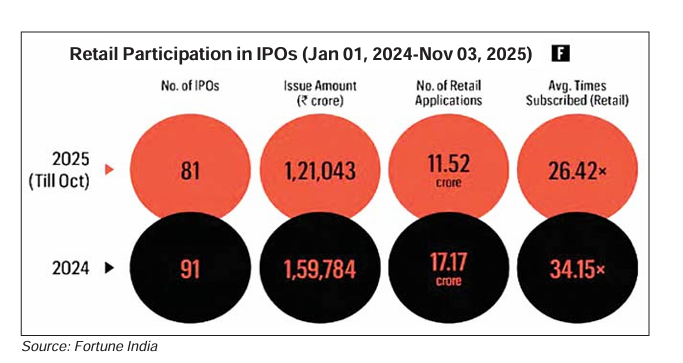
Fortune India quoting data compiled by PRIME Database Group shows that retail participation in IPOs has dipped visibly compared to 2024, despite the frenetic pace of market activity. In 2025 (till October), average retail subscription fell from a record 34.15x last year to 26.42x this year. The retail investors made 11.52 crore applications, sharply lower than 17.17 crore applications in 2024.
Mutual Funds
The Indian mutual fund industry witnessed significant growth in 2025, with assets under management (AUM) rising to ₹81 trillion in November, compared to ₹68 trillion in November 2024 — a year‑on‑year increase of 18.69%. Over the past five years, AUM has nearly tripled, recording a CAGR of 21.91%. For the first time in a calendar year, investors contributed more than ₹3 lakh crore via systematic investment plans (SIPs) up to November. According to AMFI data, SIP inflows reached ₹3.04 trillion in 2025, surpassing the ₹2.69 trillion recorded in 2024.
Market ownership
Individuals now hold a record 18.2% of the total market capitalisation of NSE-listed companies—directly and indirectly—amounting to approximately ₹74.5 lakh crore. Over the past five and ten years, their equity ownership has grown at a CAGR of 36% and 17%, respectively. For the first time in over two decades, individual investors have surpassed foreign portfolio investors (FPIs) in terms of market ownership.
Futures and Options
NSE data shows that the individual investor share in index option premium turnover rose by 508 basis points to 41.1% in November, compared with 36% in the same month last year when SEBI’s framework came into effect. In contrast, the share of proprietary traders slipped 62 basis points to 47.5%, down from 48.1% a year earlier, according to Mint.
In October, investors trading up to ₹10 lakh each contributed only 1.95% to the gross premium turnover, while those trading above ₹10 crore accounted for 69% of the total ₹11.8 trillion turnover. Within this higher‑value segment, proprietary traders led with 72.3% of the ₹8.2 trillion, followed by retail investors at 12.1% and foreign investors at 9.9%. By contrast, in the sub‑₹10 lakh category, individuals dominated with 99.8% of premium turnover, underscoring retail’s predominance in the lower‑value bucket, according to exchange data.
Cash Market
As per NSE data, retail investors withdrew ₹8,461 crore from equities in 2025 (up to December 19), marking the largest outflows since 2019. Foreign portfolio investors (FPIs) recorded their highest-ever outflows at ₹1.58 lakh crore, while domestic institutional investors (DIIs) offset this with a record infusion of ₹7.61 lakh crore.
Source:
With only 1.51 crore new demat accounts, lowest addition since 2022
Retail appetite for IPOs drops despite record ₹1.30 lakh crore fundraising
F&O trading keeps its grip on retail investors despite Sebi intervention | Stock Market News
Rising participation to propel mutual fund industry to fresh records in 2026
With only 1.51 crore new demat accounts, lowest addition since 2022